Jamgrass • String-Band Improv • Kerouac by Way of the Kittatinny Ridge
How six New Jersey players took bluegrass instruments, the spirit of the Grateful Dead, and a Jack Kerouac poem, and built one of American roots music's most beloved live bands.
The Short Version
Who Are These Guys?
Railroad Earth is an American jamgrass band formed in 2001 in Stillwater, New Jersey. They play acoustic, string-band instruments (guitar, fiddle, mandolin, banjo, upright bass) but they play them with the loose, exploratory instinct of a jam band. Long shows, songs that stretch and open up, and a devoted taping-and-festival culture are the whole point.
Two things make them singular. First, the songwriting: frontman Todd Sheaffer writes warm, literate, road-worn songs that reward close listening. Second, the improvisation: onstage those songs become vehicles for interplay between fiddle, mandolin, and guitar that can go anywhere. The band took its name from a Jack Kerouac poem, "October in the Railroad Earth," which tells you exactly what kind of American romanticism they're after.
If you already love the Grateful Dead, Old & In the Way, or the whole newgrass tradition of Sam Bush and New Grass Revival, you have already been walking toward this band your whole life.
The open-road Americana their name comes from.From a Kerouac Poem to Red Rocks
The Story
Railroad Earth did not slowly build a following. They emerged nearly fully formed, out of the ashes of another beloved New Jersey band, and were playing major festivals within a year.
2001
Formed in Stillwater, New Jersey
After the breakup of the popular Jersey band From Good Homes, singer-guitarist Todd Sheaffer joined with a group of veteran players. They rehearsed for a few weeks, cut a five-song demo live in the studio, and almost immediately landed slots at festivals like Telluride Bluegrass. The demo became their debut, The Black Bear Sessions.
2002
Bird in a House
Their second album delivered the songs that still anchor the live show, including the title track and "Like a Buddha." The blend was set: bluegrass instrumentation, folk-rock songcraft, and Celtic and jazz colors mixed in.
2004–2008
The Good Life, Elko, and Amen Corner
The Good Life (2004) and Amen Corner (2008) deepened the catalog, while the double live album Elko (2006) captured what the studio never quite could: the band in full flight, stretching songs like "Seven Story Mountain" and "Elko" into extended jams.
2010
The self-titled album and a new bassist
Their self-titled record arrived as the band's reputation as a live act peaked. Around this time Andrew Altman came in on upright and electric bass, a role he still holds.
2014
Last of the Outlaws
An ambitious, cinematic album anchored by the multi-part suite "All That's Dead May Live Again." It showed a band still pushing at the edges of what a string band could be on a studio record.
2018
Losing Andy Goessling
Founding multi-instrumentalist Andy Goessling, the band's secret weapon on everything from banjo and dobro to saxophone and flute, died of cancer on October 12, 2018, after stepping back from touring the year before. His loss was profound, and it reshaped the band.
2022
All for the Song
Their first studio album in eight years, and the most emotional of their career. Made in the wake of Goessling's death, it includes "The Great Divide," Sheaffer's aching tribute to his fallen bandmate.
2026
Still on the rails
More than two decades in, Railroad Earth remains a working touring band with a fiercely loyal audience, releasing new singles and continuing the long-show, every-night-is-different tradition that made their name.
Four Songs, One Conversion
Start Here
Railroad Earth is a live band before it is a studio band, so start with performances. Watch these four in order. By the end of the last one, you will understand the whole appeal.
01 · The Signature Song
"Bird in a House"
If Railroad Earth has an anthem, this is it: a hopeful, rolling Sheaffer song about wanting to be free. Start here and you'll hear the band's core in miniature, the fiddle and mandolin trading lines under a warm, singable melody.
02 · The Jam Vehicle
"Seven Story Mountain" — live, Bonnaroo 2011
This is where you understand why people follow this band around the country. A slow-building epic named after Thomas Merton's memoir, it climbs from quiet fingerpicking to a soaring, full-band peak. The definitive Railroad Earth experience.
03 · The Feel-Good Staple
"Like a Buddha"
A joyful, breezy fan favorite from Bird in a House that shows the band's lighter, folk-rock side. This is the one that gets the whole crowd moving, proof that the jams sit on top of genuinely great songs.
04 · The Deep End
"Elko" — live with Anders Beck
An instrumental-heavy showcase (here with Greensky Bluegrass's Anders Beck sitting in on dobro) that turns into a full-blown improvisational conversation. Once this one grabs you, you're not a curious listener anymore. You're a fan.
The Studio Catalog
The Albums 7 to start with
The studio records are the songbook; the live shows are where those songs come alive. Here's the map, with the copper-topped cards marking the best entry points.
2001
The Black Bear Sessions
The debut, cut live in the studio in the band's first weeks together. Loose, warm, and already unmistakably them, it introduced "Seven Story Mountain" and "Head."
The best starting point. Home to the anthem "Bird in a House" and "Like a Buddha," it's the album where the band's blend of songcraft and string-band fire fully clicked.
A sunnier, more expansive record. The songwriting broadened and the arrangements got more adventurous while keeping the road-worn warmth at the center.
The self-titled album, arriving as the band's live reputation crested. A strong, representative set for anyone who wants the definitive studio-era Railroad Earth sound.
The most personal album they've made, written in the shadow of Andy Goessling's passing. "The Great Divide" is a tribute that will wreck you in the best way.
Two YouTube Music playlists: a First Listen to walk you in through the front door, and a Deep Cuts set for once the fiddle and mandolin have their hooks in you. Hit the button on either card to play it.
Railroad Earth is a true ensemble. The magic is the interplay, the way fiddle, mandolin, and guitar pass melodies back and forth like a single instrument with many voices.
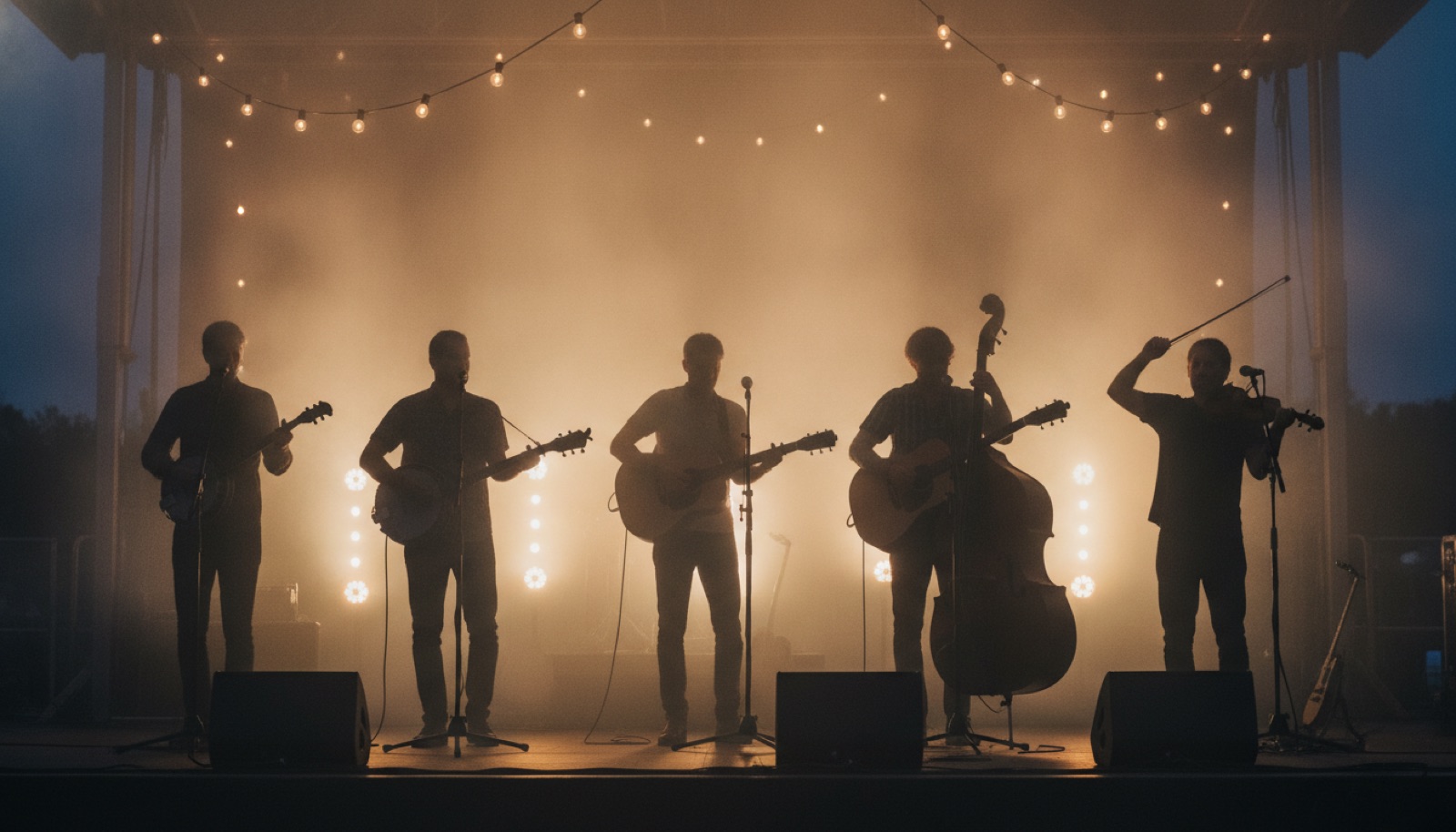
The ensemble on a festival stage at dusk.
Todd SheafferGuitar / VoxFounder, lead singer, and principal songwriter; the warm literate voice at the band's center
Tim CarboneViolin / VoxThe fiery, expressive fiddle that so often leads the jams; also a noted producer
John SkehanMandolinMandolin and bouzouki; a melodic anchor and a key improvisational voice
Carey HarmonDrums / VoxFounding drummer; the pulse that lets a string band actually swing and rock
Andrew AltmanBassUpright and electric bass; joined around 2010 and has held down the low end since
Mike RobinsonMulti-Instr.Joined touring in 2019 on banjo, dobro, pedal steel and more, helping carry the many roles Andy Goessling once filled
In Memoriam · Andy Goessling · 1959–2018
A founding member and the band's true multi-instrumentalist, Andy Goessling played guitar, banjo, dobro, mandolin, saxophone, clarinet, flute, and nearly anything else with strings or a reed. He stepped back from touring in 2017 for cancer treatment and died on October 12, 2018. His fingerprints are all over the early catalog, and the band's 2022 album All for the Song stands as a tribute to him. When you hear those records, you are hearing him.
The Roots of the Sound
Influences
Railroad Earth's jamgrass sits where bluegrass meets the endless jam. These are the records that made that possible.
The Jam Tradition
Grateful Dead
The improvisational spirit they plug their string band into, right down to the taping culture.
The band is happy to talk craft, and hearing them explain the improvisation makes the live shows land even harder. Two to watch.
Interview · eTown
Todd Sheaffer On Stage
An on-stage eTown interview with frontman and songwriter Todd Sheaffer on where the songs come from and how a string band ended up chasing the endless jam.
Fiddle player Tim Carbone talks improvisation, the festival scene, and the band's live-first philosophy from backstage at a mountain bluegrass festival.
Once the band gets its hooks in you, the ecosystem around it, built on the same taper-and-setlist culture the Grateful Dead invented, is deep and welcoming.
Bound for the next town.
The live tapes — decades of shows circulate freely on the Internet Archive (archive.org) and elsewhere. Because no two setlists repeat, digging through years of recordings is its own reward.
Hangtown & the festivals — the band has long anchored its own festival culture, and their festival sets are where the deepest, longest jams tend to happen. Seek them out.
Start with a full show — pick a well-regarded night (a New Year's run or a Red Rocks show is a safe bet) and listen front to back, the way it was played. The pacing of a full set is part of the art.
The songbook runs deep — beyond the staples, chase down "Elko," "Mighty River," "Mourning Flies," and the Last of the Outlaws suite once the essentials have taken hold.
A Good Way In
If you only do one thing after this page: put on the live "Seven Story Mountain" above, then queue up Bird in a House start to finish. That is the fast track from curious to converted, and there are twenty-plus years of shows waiting on the other side.