How an elegant pianist from Washington built the greatest orchestra jazz has ever known and, over fifty years, became the most important composer America has produced.
The Short Version
Who Is This?
Duke Ellington was an American composer, pianist, and bandleader, active from the 1920s until his death in 1974, who led the greatest orchestra in the history of jazz and stands as the most important composer the United States has produced. His music is so rich that he disliked the label "jazz" and preferred to call it, simply, "beyond category."
Two things make him singular. First, the composition: he wrote hundreds of pieces, from three-minute masterpieces to extended suites, with a harmonic and orchestral imagination unmatched in the music. Second, the orchestra: he wrote for the specific voices of his players, treating the band itself as his instrument for nearly fifty years.
He is jazz at its grandest and most sophisticated, a bridge between the dance hall and the concert hall. If you want a way into jazz through the mind of its greatest composer, start here.
The elegance and depth of a singular composer.Fifty Years at the Top
The Story
Ellington rose from the Harlem clubs to the world's concert halls, leading his orchestra without pause for half a century and continually expanding what the music could be.
1899
Born in Washington, D.C.
Raised in a genteel Black middle-class family, the young "Duke" was schooled in manners and music, and set out for New York to make his name as a pianist and bandleader.
1927
The Cotton Club
His residency at Harlem's famous Cotton Club, broadcast nationwide on the radio, made his orchestra famous and let him develop his "jungle" sound and his gift for atmosphere.
1931 – 1932
Mood Indigo and the standards
A run of enduring compositions, "Mood Indigo," "It Don't Mean a Thing," "Sophisticated Lady," established him as a composer of American standards, not just a bandleader.
1940 – 1943
The Blanton-Webster band and Billy Strayhorn
With his brilliant collaborator Billy Strayhorn, who wrote "Take the A Train," and a peerless band, he entered the era many consider his greatest, and premiered the extended work Black, Brown and Beige at Carnegie Hall.
1956
Newport
A legendary performance at the Newport Jazz Festival, with saxophonist Paul Gonsalves's electrifying solo, revived his career and put him on the cover of Time magazine.
1960s – 1974
Suites, the world, and the sacred
He toured the globe, wrote ambitious suites like The Far East Suite, and devoted his last years to his Sacred Concerts, composing to the very end.
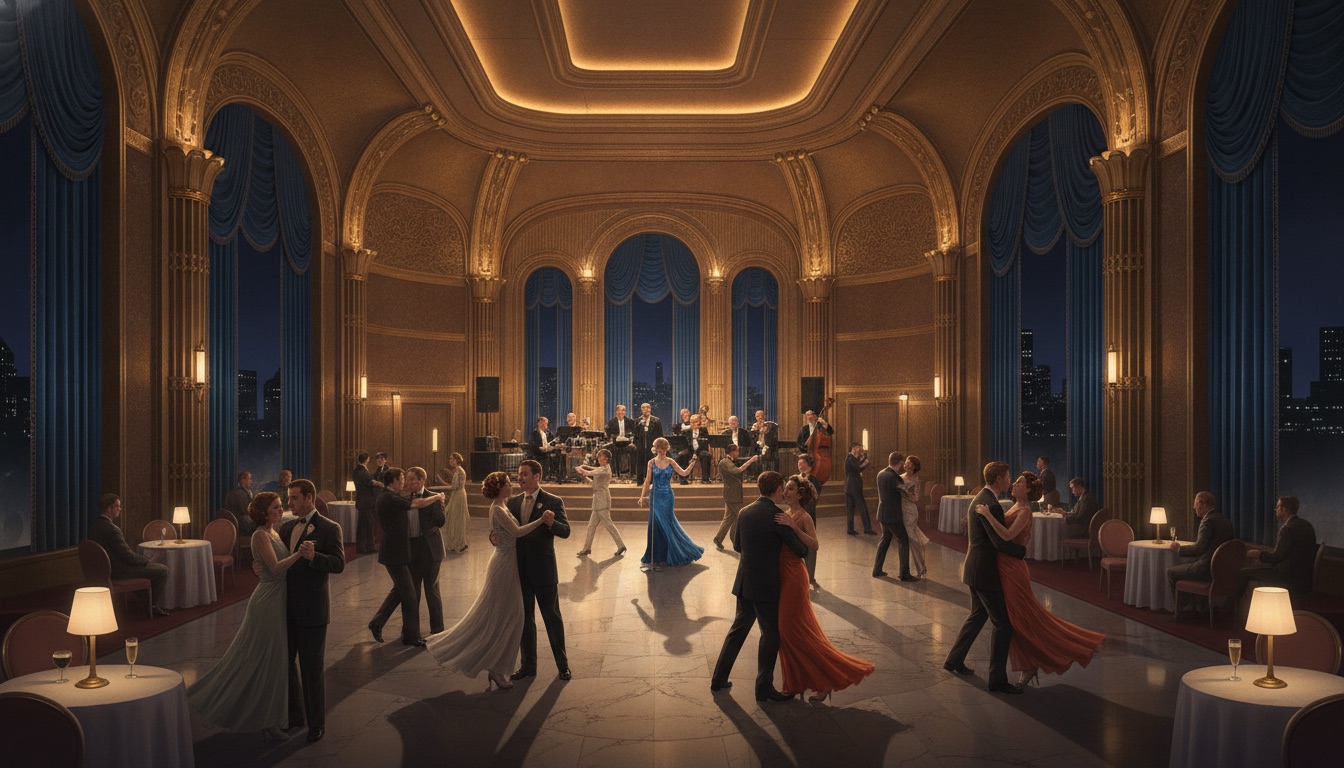
The ballroom and the concert hall, joined in one music.Three Pieces, One Education
Start Here
Three pieces that hold his whole world: the signature theme, the atmospheric ballad, and the swing anthem. Listen in order.
01 · The One to Play First
"Take the 'A' Train" — 1941
His orchestra's signature theme, written by his collaborator Billy Strayhorn: bright, swinging, and instantly recognizable. The perfect front door to the Ellington sound.
02 · The Atmosphere
"Mood Indigo" — 1930
A hushed, blue, gorgeously voiced ballad whose unusual instrumental blend showed how much feeling and color Ellington could conjure. Pure atmosphere.
03 · The Anthem
"It Don't Mean a Thing (If It Ain't Got That Swing)" — 1932
The song that gave the Swing Era its motto, here performed with Ella Fitzgerald. Joyful and definitive, it captures the whole spirit of the music.
The Studio Catalog
The Albums 5 to start with
Ellington's catalog is vast; these five are landmark doorways from the LP era. The gold-topped cards mark the best entry points; the moss-green marks the earliest era here.
1956
Ellington at Newport
The electrifying comeback concert that revived his career, famous for Paul Gonsalves's marathon solo. Thrilling, live, and the perfect place to start.
A studio recording of his ambitious extended work on Black American history, graced by the great gospel voice of Mahalia Jackson on "Come Sunday." Profound and moving.
A fiery, intimate trio date with Charles Mingus on bass and Max Roach on drums. A rare, exposed look at Ellington the pianist, sparking off two younger giants.
One curated YouTube Music playlist gathering the essential themes and pieces. (Ideally, though, spend time with Ellington at Newport whole.) Hit the button below to play it.
Essentials
Across the Catalog · 12 tracks
Take the "A" TrainEllington Orchestra
Mood IndigoEllington Orchestra
It Don't Mean a ThingEllington Orchestra
Sophisticated LadyEllington Orchestra
In a Sentimental MoodEllington Orchestra
Diminuendo and Crescendo in BlueEllington at Newport
Duke Ellington's true instrument was his orchestra. Rather than write for generic sections, he composed for the specific sound of each of his players, the creamy alto of Johnny Hodges, the growling trumpet of Cootie Williams, the enormous baritone of Harry Carney, so his music could never quite be reproduced by anyone else's band.
He kept many of those musicians for decades, an extraordinary loyalty that let him develop his ideas across a lifetime. He also had, in Billy Strayhorn, one of the great collaborators in music history, a composer and arranger so close in sensibility that their work is often impossible to tell apart.
As a composer he was uniquely ambitious. He wrote perfect three-minute miniatures and sprawling suites, sacred concerts and film scores, blurring the line between jazz and American classical music. He resisted every attempt to box him in, insisting his work was simply "beyond category."
What makes him worth following is the sheer scale and richness of the achievement. Fifty years of leadership, thousands of compositions, and a body of work that stands with any composer's. To know American music is, sooner or later, to come to Duke Ellington.
Music written for the voices of specific men.The Roots of the Sound
Influences
Ellington grew out of stride piano, early jazz, and the colors of classical music. Here are four touchstones.
The Stride
James P. Johnson
The father of Harlem stride piano was the young Ellington's model at the keyboard, and the rolling, orchestral left hand of stride underpins his playing.
Armstrong reinvented jazz as a soloist's art and defined its swing and feeling. His influence shaped how Ellington's players phrased and how the whole music breathed.
The soprano saxophone master's huge, vibrato-rich tone was an early revelation for Ellington, who briefly employed him and prized the vocal expressiveness he brought to a horn.
The impressionist composer's lush, coloristic harmony is a clear kin to Ellington's own gift for orchestral color and mood, the classical side of his "beyond category" sound.
Ellington was famously urbane, gracious, and quotable, a master of the elegant deflection. A late-career television conversation, and a classic 1957 profile.
Interview · The Dick Cavett Show
A Late Conversation
A charming, witty television exchange that captures Ellington's famous urbanity and grace, the same elegance that runs through all of his music.
A vintage television visit with Ellington near the height of his fame, a window into the man, his world, and the effortless sophistication that defined him.
Once the essentials have you, an ocean of music opens up.
The Blanton-Webster Band (1940-1942) — many consider this three-year run the greatest of his career; the recordings are essential.
Billy Strayhorn — his collaborator and alter ego, composer of "Take the A Train" and "Lush Life," is a whole rewarding path of his own.
The Sacred Concerts — his late religious works, which he considered his most important music, show a different, devotional side.
Money Jungle and the collaborations — his summit meetings with John Coltrane, Charles Mingus, and Max Roach reveal Ellington sparking against the modernists.
The Way to Listen
Start with Ellington at Newport for the live thrill, then explore Such Sweet Thunder to hear the composer's imagination at full stretch.