
A Beginner's Guide To

Ray Charles

Soul • R&B • The Genius

The man who put gospel fervor into secular songs and invented soul music, then refused to stay inside it, taking the same voice into jazz, country, and standards until the categories stopped mattering.


The Short Version

Who Was He?

Ray Charles did something in 1954 that sounds obvious now and was close to scandalous then. He took the sound of the Black church, the call and response, the moaning, the ecstatic release, and put it behind songs about wanting a woman rather than wanting salvation. Gospel had never been used that way. What came out the other side was soul music.

Then he refused to be its prisoner. Over the next decade he made a big-band jazz record, a blues record, and, in 1962, an album of country songs that became the best-selling record of his career and one of the most quietly radical gestures in American music.

People called him The Genius, a nickname he found slightly embarrassing. The case for it is simple: almost nobody else changed the shape of a genre and then walked out of it.

An empty rural Georgia road at golden hour, pine trees and red clay in warm sepia light
Albany, Georgia, where he was born, and the country roads his music kept returning to.

From Greenville to the Genius

The Story

Seventy-three years, and a career that kept refusing the box it had just been put in.

  1. 1930

    Born in Albany, Georgia

    Born September 23, 1930, and raised in Greenville, Florida. He began losing his sight around age four or five and was blind by seven, most likely from glaucoma.

  2. 1937

    The Florida School for the Deaf and the Blind

    He attended the school in St. Augustine from 1937 to 1945, where he learned to read and write music in braille. The formal training underneath the feel starts here.

  3. 1949

    First chart record

    "Confession Blues" reaches number two on the Billboard R&B chart. At this point he is working in the smooth, elegant style of Nat King Cole and Charles Brown, and sounds very little like himself.

  4. 1954

    "I've Got a Woman" and the invention of soul

    Recording for Atlantic, he takes the structure and fervor of a gospel song and writes secular words over it. It reaches number two on the R&B chart, draws real anger from churchgoers, and changes popular music permanently.

  5. 1959

    "What'd I Say"

    Six minutes of electric piano, call and response with the Raelettes, and mounting frenzy. It reaches number six on the pop chart and number one R&B, and finally breaks him to a white audience.

  6. 1960

    "Georgia on My Mind," his first number one

    Newly signed to ABC-Paramount, he turns a 1930 standard into something that sounds like memory itself. It becomes his first number one hit.

  7. 1962

    Modern Sounds in Country and Western Music

    A Black R&B star records an album of country songs, at a moment when American radio and American life were both strictly segregated. It tops the Billboard 200 and becomes the biggest record he ever made.

  8. 1964

    The arrest, and getting clean

    Arrested at Boston's Logan Airport on Halloween for heroin possession, after years of addiction. He entered a hospital, went through four days of withdrawal, and quit. He received a suspended sentence, probation, and a fine, and resumed his career.

  9. 2004

    Genius Loves Company, and the end

    He died on June 10, 2004, in Beverly Hills, of complications from liver failure. The duets album he finished shortly before became the biggest commercial success of his late career.

Three Videos, One Introduction

Start Here

Three performances, in the order the story happened. Watch what changes and what does not.

01 · The Invention

"What'd I Say" on The Ed Sullivan Show

The call and response with the Raelettes, the electric piano, the build that will not stop building. This is the church, moved somewhere it was not supposed to go.

Watch on YouTube ↗
02 · The Ballad

"Georgia on My Mind" live

The other half of the instrument. All the force from the first video, held back almost entirely, which turns out to be harder and more affecting.

Watch on YouTube ↗
03 · The Crossing

"I Can't Stop Loving You" live

A country song, sung by a soul singer, with strings and a choir behind him. In 1962 this combination was close to unthinkable. Here it just sounds inevitable.

Watch on YouTube ↗

The Studio Catalog

The Albums 5 to start with

His singles are the famous part, but these five records are where you can hear him deciding what he wanted to be next.

1959

The Genius of Ray Charles

Half big-band swing, half aching ballads with strings. The album that argued he was not just an R&B act.

Open in Apple Music ↗
1962

Modern Sounds in Country and Western Music

The essential one. A soul singer takes on Hank Williams and the Everly Brothers and makes the biggest record of his life.

Open in Apple Music ↗
1959

What'd I Say

The Atlantic years at full boil, built around the six minutes that broke him nationally.

Open in Apple Music ↗
1961

The Genius Sings the Blues

The deepest, darkest record here, and the best place to hear what gospel phrasing does to a blues.

Open in Apple Music ↗
2004

Genius Loves Company

The final record, a set of duets finished shortly before his death, and a fair picture of how wide his reach had become.

Open in Apple Music ↗

Where to Drop the Needle

Playlists

One curated YouTube Music playlist of Ray Charles essentials, running roughly in the order he made them.

Essentials
The Way In · 13 tracks
  1. I Got a WomanRay Charles
  2. What'd I SayWhat'd I Say
  3. (Night Time Is) The Right TimeSings the Blues
  4. Hard TimesSings the Blues
  5. I Believe to My SoulSings the Blues
  6. Let the Good Times RollThe Genius
  7. Come Rain or Come ShineThe Genius
  8. Georgia on My MindSingle, 1960
  9. Hit the Road JackSingle, 1961
  10. I Can't Stop Loving YouModern Sounds
  11. You Don't Know MeModern Sounds
  12. Born to LoseModern Sounds
  13. Bye Bye LoveModern Sounds
▶ Listen on YouTube Music

The People on the Records

The Players

He was the writer, arranger, bandleader, and voice, but the records depend on the people he built around himself.

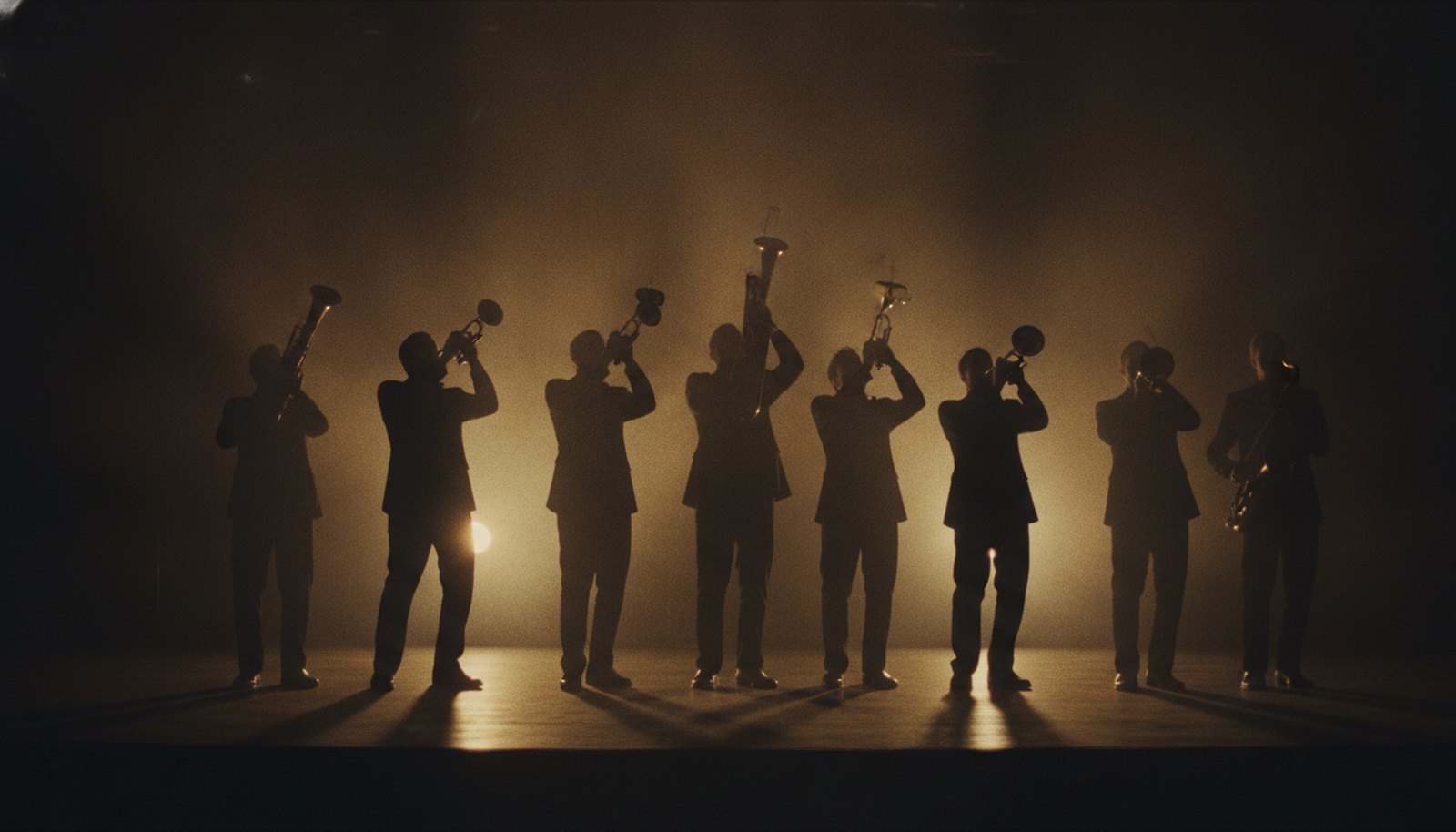
A big band horn section in silhouette on a dim stage, backlit by warm amber spotlights, no faces visible
The horn section and the vocal group that gave the songs their frame.
On the Name

The nickname "The Genius" came from Atlantic's marketing, not from him. He tended to deflect it, pointing out that he practiced constantly and had studied music formally since childhood. The label stuck anyway.


The Roots of the Sound

Influences

Two streams feed him: the polished, sophisticated piano-and-voice tradition he imitated first, and the church music he was not supposed to mix it with.

The Model

Nat King Cole

His first template. Early Ray Charles records are a young man doing a careful, skilled Nat Cole impression before finding his own voice.

Open in Apple Music ↗
The Church

Mahalia Jackson

The gospel tradition whose phrasing, restraint, and sudden release he carried directly into secular songs.

Open in Apple Music ↗
The Other Model

Charles Brown

The smooth, late-night blues style that shaped his first recordings alongside Cole.

Open in Apple Music ↗
The Showman

Louis Jordan

The jump blues bandleader whose horn-driven swing and comic timing sit underneath the up-tempo side of his catalog.

Open in Apple Music ↗
The Piano

Art Tatum

The standard every jazz pianist measured themselves against, and a reminder that there was serious technique under the feel.

Open in Apple Music ↗

In His Own Words

Interviews

Two long conversations, thirty years apart, both with him doing the talking.

Interview · The Dick Cavett Show

"The Genius," 1972

A full-length conversation from the show's own archive, with Charles talking through his career at the height of it.

Watch on YouTube ↗
Interview · NPR Fresh Air

On country music, 1998

Charles explaining, in his own words, why the country record was never the strange departure everyone treated it as.

Watch on YouTube ↗

The Rabbit Hole

Going Deeper

The catalog is enormous and unevenly served by compilations. A few directions worth taking.

The Way to Listen

Play "I've Got a Woman" and then a gospel record from the same period back to back. The borrowed structure is unmistakable once you hear it, and so is the reason it caused so much trouble at the time.


Radio