How a self-taught left-hander who paid his dues on the chitlin circuit reinvented the electric guitar in barely four years, turning feedback, fuzz, and sheer sound into a new language that every player since has had to answer.
The Short Version
Who Is He?
Jimi Hendrix (born Johnny Allen Hendrix in Seattle in 1942) is the most influential electric guitarist who ever lived. Largely self-taught and playing a right-handed Stratocaster flipped upside down and restrung, he spent years as an anonymous sideman before exploding into fame in London in 1966 and rewriting what the instrument could do.
Two things make him singular. First, the sound: he treated feedback, distortion, the wah pedal, and the whammy bar as expressive tools rather than accidents, coaxing textures out of an amplifier that no one had imagined. Second, the touch: underneath the fireworks was a deep blues and rhythm-and-blues player with an unmatched sense of feel, able to play rhythm and lead at once.
His mainstream career lasted less than four years and he died in 1970 at twenty-seven, yet he left a catalog and an influence so vast that modern guitar is still measured against him. To understand rock guitar, you start here.
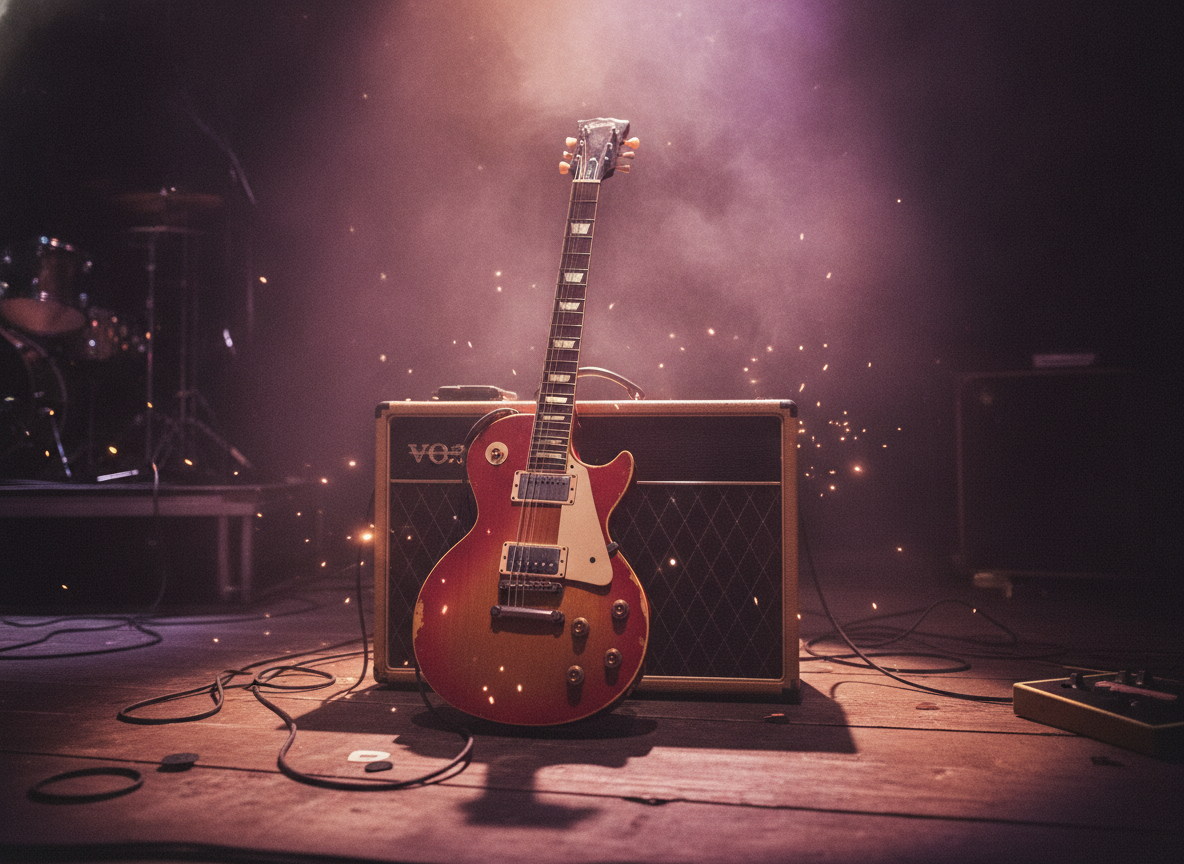
Purple haze and pure sound, the atmosphere Hendrix conjured out of an amplifier.From the Chitlin Circuit to the Monterey Stage
The Story
Hendrix's rise was astonishingly fast, a long apprenticeship in the shadows followed by a few incandescent years that changed music forever.
The stage as an instrument in itself, sound and spectacle fused into one act.
1962–1965
The sideman years
After a brief Army stint, Hendrix worked the chitlin circuit as a backing guitarist for the Isley Brothers, Little Richard, and others. He learned showmanship and discipline on the road, but his wild instincts kept getting him fired.
1966
Discovered in New York
Fronting his own band in Greenwich Village, he was spotted by Chas Chandler of The Animals, who saw a star and persuaded Hendrix to come to London, where the guitar scene was ready to be turned upside down.
1966–1967
The Experience
Chandler paired him with bassist Noel Redding and drummer Mitch Mitchell to form the Jimi Hendrix Experience. Rapid-fire singles and the debut Are You Experienced stunned London and made him an overnight sensation.
1967
Monterey
Returning to America, he detonated at the Monterey Pop Festival, closing his set by dousing his guitar in lighter fluid and setting it ablaze. It was the moment the wider world understood what he was.
1968
Electric Ladyland
The sprawling double album pushed the studio itself into new territory, from the churning "Voodoo Child (Slight Return)" to a definitive reading of Bob Dylan's "All Along the Watchtower." The peak of the Experience.
1969
Woodstock
Closing the festival at dawn before a thinning crowd, Hendrix delivered a searing solo "Star-Spangled Banner" that became the defining sound of the era, protest and beauty wrung from feedback.
1970
Band of Gypsys and after
He formed the harder, funkier Band of Gypsys with Billy Cox and Buddy Miles, cut the live album of the same name, and was reaching for new directions when he died in London that September at twenty-seven.
Four Songs, One Education
Start Here
The catalog is deep but the entry point is clear. These four tracks move from the pop-single jolt to the electric epic to the blues-drenched groove. Listen in order.
01 · The Calling Card
"Purple Haze" (1967)
The riff that announced a revolution: a jagged, tritone-driven hook, a swaggering vocal, and a solo that seems to bend the air. Three minutes that told the world a new kind of guitar had arrived.
02 · The Transformation
"All Along the Watchtower" (1968)
Hendrix took a spare Bob Dylan song and rebuilt it into a rolling, thunderstruck epic. Dylan himself said he never heard the tune the same way again. The definitive cover in rock history.
03 · The Storm
"Voodoo Child (Slight Return)" (1968)
Wah-pedal thunder and swaggering blues muscle, the closer of Electric Ladyland and the sound of Hendrix at full, elemental power. This live reading shows how the storm played out on stage.
04 · The Debut Single
"Hey Joe" (1966)
The slow-burning first single that broke him in London. A traditional tune reshaped into a smoldering showcase for his phrasing and feel, the calm blues heart under all the fireworks.
The Landmark Records
The Albums 4 to start with
Hendrix released only four albums in his lifetime, three with the Experience and one live record with Band of Gypsys. Together they are the whole of the essential catalog. The blue-topped card is the best place to begin.
1967
Are You Experienced
The debut that changed everything. "Purple Haze," "Foxy Lady," "Hey Joe," "The Wind Cries Mary," and "Fire" arrive in a rush, a full-formed new sound that still sounds like the future. The place to start.
Recorded fast on the heels of the debut, a more melodic and colorful record. "Little Wing," "Castles Made of Sand," and "Bold as Love" reveal Hendrix the tender songwriter and studio painter.
The masterpiece. A sprawling double album that pushed the studio to its limits, from "Voodoo Child (Slight Return)" to "1983... (A Merman I Should Turn to Be)" to the definitive "All Along the Watchtower."
The lone live album released in his lifetime, cut with Billy Cox and Buddy Miles. Heavier and funkier than the Experience, its "Machine Gun" is one of the towering guitar performances ever recorded.
Two YouTube Music playlists: a First Listen of the signature songs to bring you in, and a Deep Cuts set of the longer, headphone-reward pieces for when you want to sink in. (Ideally, though, hear these albums whole.) Hit the button on either card to play it.
Hendrix was the star, but his sound was carried by two remarkable trios and the men behind the glass who helped him chase it. These are the players and craftsmen on the essential records.
The psychedelic swirl of the late sixties, the world the Experience gave a soundtrack.
Noel ReddingBass, the ExperienceA guitarist switched to bass, his driving, melodic lines anchored the Jimi Hendrix Experience across all three studio albums
Mitch MitchellDrums, the ExperienceA jazz-schooled powerhouse whose loose, exploratory playing was the perfect foil for Hendrix, pushing the trio toward improvisation
Billy CoxBass, Band of GypsysAn Army friend and steady anchor, his deep, funky bass drove the later Band of Gypsys and the final tours
Buddy MilesDrums, Band of GypsysA hard-hitting soul and funk drummer whose heavier groove reshaped Hendrix's sound on the Band of Gypsys live album
Chas ChandlerProducer and managerThe former Animals bassist who discovered Hendrix, brought him to London, formed the Experience, and produced the early records
Eddie KramerEngineerThe studio engineer behind the Experience albums and Electric Lady Studios, a key partner in realizing Hendrix's expansive sonic ideas
The Roots of the Sound
Influences
Beneath the fireworks, Hendrix was a blues and rhythm-and-blues player to the core, steeped in Chicago electric blues, the showmanship of early rock and roll, and the poetry of the folk-rock era. Here is where it started.
Blues
Muddy Waters
The Chicago electric blues that Hendrix absorbed as a boy. Waters's amplified slide and commanding presence were a bedrock, the sound Hendrix would take somewhere entirely new.
The singing, vocal-like lead phrasing and the discipline of saying more with fewer notes. King's expressive touch shaped the tender, blues-drenched side of Hendrix's playing.
Hendrix played guitar in Little Richard's touring band and learned showmanship at its source, the flamboyance and raw energy that he would later channel into his own stage act.
A liberating example for a songwriter finding his voice. Dylan's imagery emboldened Hendrix to write more freely, and his "All Along the Watchtower" became Hendrix's greatest reinvention.
Offstage, Hendrix was soft-spoken, funny, and thoughtful, a striking contrast to the wild figure on stage. His rare filmed conversations show the quiet, curious man behind the guitar.
Interview · 1969
The Dick Cavett Show
His US network television debut. Hendrix talks candidly about pressure, breakdowns, and his Woodstock "Star-Spangled Banner," gently pushing back when Cavett calls the performance controversial.
Interview · 1969
On Woodstock and Super Groups
A relaxed, revealing conversation covering the anthem controversy, the idea of the super group, and his own restless search for a bigger, freer sound. Hendrix at his most disarming.
The Rabbit Hole
Going Deeper
Once the four albums have you, Hendrix's world opens into a vast trove of live recordings, studio outtakes, and the music he was reaching toward when he died.
The live legend. the Monterey Pop and Woodstock performances, plus the Live at the Fillmore East Band of Gypsys sets, capture a performer who transformed his songs every night.
First Rays of the New Rising Sun. the album he was assembling when he died, reconstructed from his final sessions, a window into where the music was headed.
The Experience singles. early sides like "The Wind Cries Mary" and "Burning of the Midnight Lamp" show his gift for the concise, gorgeous three-minute song.
The films. Jimi Hendrix (1973), Jimi Plays Monterey, and the Woodstock footage are the best filmed windows into the phenomenon on stage.
The Way to Listen
Do yourself one favor: put on Are You Experienced from start to finish, then Electric Ladyland. Use good headphones and turn it up. So much of what Hendrix did lives in the texture, the panning, and the feel, and it only opens up when you give it your full attention.